

Swale Mums: Building a Community Where No Mother Has to Navigate Motherhood Alone
Peer support, belonging and practical wellbeing are at the heart of Diversity House’s Swale Mums Peer Support Circles, a 12-week community programme designed to help mothers build confidence, strengthen wellbeing and create lasting connections.
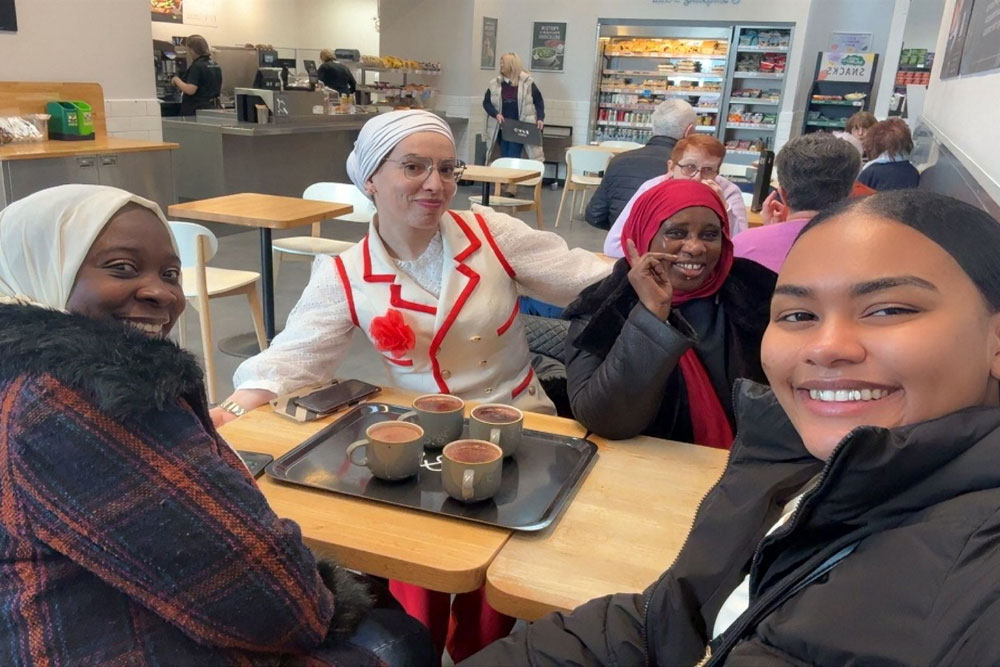
Picture 1. Swale Mums participants coming together for a relaxed peer-support and wellbeing activity.
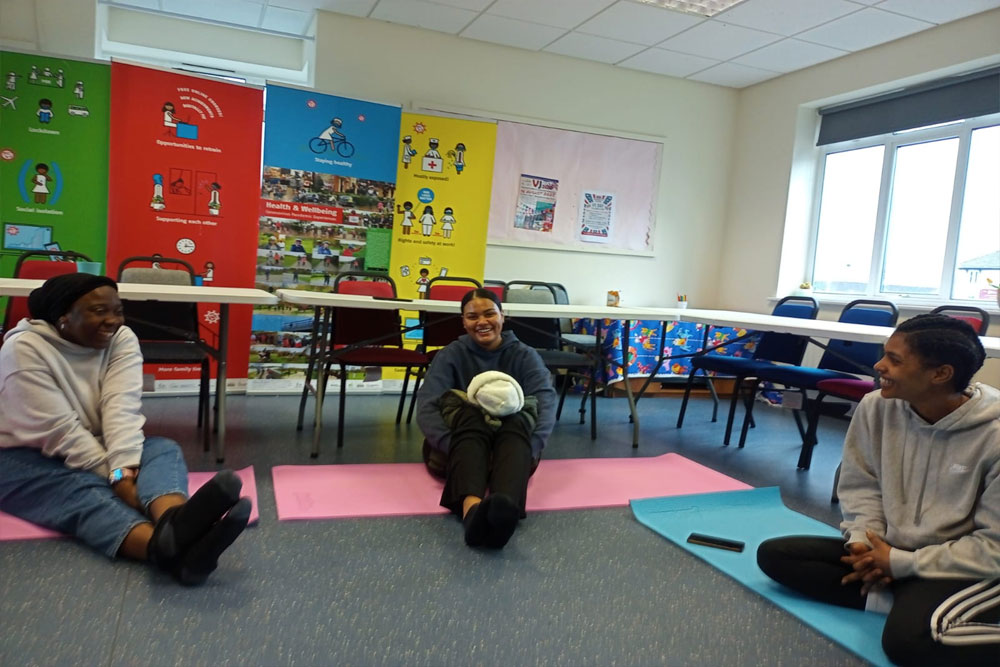
Picture 2. A group of mothers sitting together on exercise mats in a community room during a peer-support activity.
The photographs from Swale Mums capture something that statistics cannot: women coming together, learning from one another, sharing experiences and creating a space where motherhood does not have to feel isolating.
Motherhood can be joyful and still be hard
Becoming a mother can bring love, excitement and a profound sense of purpose. It can also bring exhaustion, anxiety, uncertainty, changes in identity, financial pressure, relationship changes and the feeling that everyone else somehow knows what they are doing. For some women, the hardest part is not simply the challenges themselves. It is feeling that they have to deal with them alone. That is why Swale Mums Peer Support Circles was created. The programme brings mothers together in a safe, welcoming and culturally inclusive environment where they can talk, listen, learn, laugh, reflect and develop practical tools for looking after their own wellbeing.
Swale Mums is a 12-week programme combining face-to-face sessions in Sittingbourne with hybrid provision for mothers in Sheppey and elsewhere. Sessions are designed for small groups of around 8–12 mothers and are facilitated by trained peer facilitators, supported by a Project Officer and, where appropriate, health professionals and other specialist contributors.
Importantly, this is community support rather than a replacement for clinical care. Where additional help is needed, the programme aims to connect mothers with appropriate health, Family Hub and community services.
Why a project like Swale Mums matters
The case for investing in women’s mental wellbeing around pregnancy and early motherhood is strong.
The Women’s Health Strategy for England, published in 2022, identified fertility, pregnancy, pregnancy loss and postnatal support as major areas of concern. Its consultation highlighted concerns that postnatal support can sometimes focus heavily on the baby while the mother’s own health and wellbeing receive less attention (Department of Health and Social Care, 2022).
Mental health was also one of the most frequently selected topics in the national consultation. Thirty-nine per cent of respondents selected mental health as a priority, while only 34% said they or the woman they had in mind had access to enough information about mental health conditions. The strategy also highlighted inequalities in women’s experiences and access to support (Department of Health and Social Care, 2022). This evidence remains highly relevant to the rationale for Swale Mums. However, it is important to recognise that the 2022 strategy has since been withdrawn. In April 2026, the Government published a Renewed Women’s Health Strategy for England, establishing the current national framework for improving women’s health over the next decade and placing women’s voice, choice and power at the centre of the approach (Department of Health and Social Care, 2026).
For Diversity House, the message is clear: women’s experiences need to be heard, inequalities need to be addressed, and support needs to be accessible in ways that reflect women’s lives. Swale Mums translates those principles into a local, practical response.
The local picture is equally important
National policy provides the wider context. Kent’s evidence shows why this work matters locally.
Kent County Council’s Nurturing Little Hearts and Minds: Perinatal Mental Health and Parent-Infant Relationships Strategy 2024–2029 provides a strong local rationale for early, preventative and inclusive support.
Kent estimates that 6,663 parents and carers could benefit from mild-to-moderate perinatal mental health support every year, alongside an estimated 2,937 parent-infant relationships that could benefit from additional support (Kent County Council, 2024).
The strategy emphasises the importance of providing support early, before difficulties become more severe, and recognises the effects that social isolation, financial pressures and wider circumstances can have on families (Kent County Council, 2024).
This is particularly important because perinatal wellbeing does not exist in isolation from the circumstances in which families live.
The Kent Public Health Observatory describes health inequalities as unfair and avoidable differences in health between groups and highlights the importance of socioeconomic circumstances, geography and inclusion-health factors. Its Swale profile identifies the significance of inequalities linked to socioeconomic circumstances, geography and other characteristics (Kent Public Health Observatory, n.d.).
For Diversity House, this reinforces a simple principle:
Good mental-health support does not always begin in a clinic. Sometimes it begins with being welcomed into a room where someone says, “You are not alone.”
Tackling inequality means making support accessible
Health inequalities are not simply about illness. They are also about whether people can access the right support, at the right time, in a way that works for them.
The Kent perinatal mental-health strategy found that only 2% of professionals surveyed believed all groups were well served by the existing perinatal mental-health offer, while 23% of parents and carers reported experiencing discrimination. The strategy therefore identifies equity, inclusivity and responsive services as important areas for action (Kent County Council, 2024).
Swale Mums has been deliberately designed with these challenges in mind.
The programme incorporates:
- face-to-face and hybrid participation;
- provision reaching Sittingbourne, Faversham and Sheppey;
- optional one-to-one peer support;
- consideration of transport and participation barriers;
- culturally inclusive activities;
- consideration of language and literacy;
- sensitivity to faith, family structures and dietary requirements;
- women-only provision where appropriate; and
- signposting into local health and community services.
The project also recognises that some mothers may find group settings difficult because of anxiety, childcare responsibilities or mobility issues. The enhanced programme therefore includes optional one-to-one peer mentoring and virtual resources alongside the group sessions.
Accessibility is not an additional feature of Swale Mums. It is part of the design.
From connection to confidence: what happens in the circles?
Swale Mums is deliberately broader than a conventional information session.
Across 12 weeks, mothers explore practical aspects of mental and physical wellbeing, relationships, confidence and community connection. The programme includes:
Week 1 — Welcome and Building Trust
Creating a safe space, getting to know one another and beginning to build a supportive peer network.
Week 2 — Understanding Mental Wellbeing
Exploring emotions, stress and mental wellbeing, with an introduction to the Warwick-Edinburgh Mental Wellbeing Scale (WEMWBS).
Week 3 — Coping and Resilience
Exploring breathing, grounding, journaling and practical strategies that mothers can use in everyday life.
Week 4 — Nutrition and Wellbeing
Looking at nutrition, energy and wellbeing through practical and culturally responsive approaches.
Week 5 — Bonding and Infant Care
Exploring mother-infant bonding, infant care and practical questions around caring for a baby.
Week 6 — Physical Activity for Mind and Body
Exploring gentle movement, stretching and realistic ways to incorporate physical activity into family life.
Week 7 — Sleep and Self-Care
Recognising the importance of rest and developing small, achievable approaches to self-care.
Week 8 — Confidence and Communication
Building confidence, communicating needs and learning how to ask for help.
Week 9 — Managing Anxiety and Low Mood
Recognising common experiences and exploring practical coping strategies in a supportive environment.
Week 10 — Community Connections and Signposting
Helping mothers understand and navigate Family Hubs, NHS services, Diversity House and other community resources.
Week 11 — Celebrating Strengths
Using creative activities, reflection and peer recognition to recognise progress and celebrate strengths.
Week 12 — Closure and Next Steps
Reflecting on learning, completing the wellbeing evaluation and considering how peer and community connections can continue.
The enhanced programme also includes weekly wellbeing tips, virtual resources, family involvement, creative activities, small wellbeing challenges, peer-led activities and opportunities for longer-term peer connection.
Peer support is the difference
There is something powerful about hearing from someone who has been there.
NHS England describes peer support as bringing people with shared experiences together to develop mutual understanding and create an encouraging, safe environment. It can support knowledge, confidence, self-management and resilience, while also helping address issues such as loneliness and self-esteem (NHS England, 2023).
Crucially, NHS England recognises that peer support can take many forms, including one-to-one support, online support, informal groups and structured groups such as perinatal mental-health groups. It also emphasises that peer support does not replace clinical care, but complements professional advice, treatment and information (NHS England, 2023). That principle is at the heart of Swale Mums.
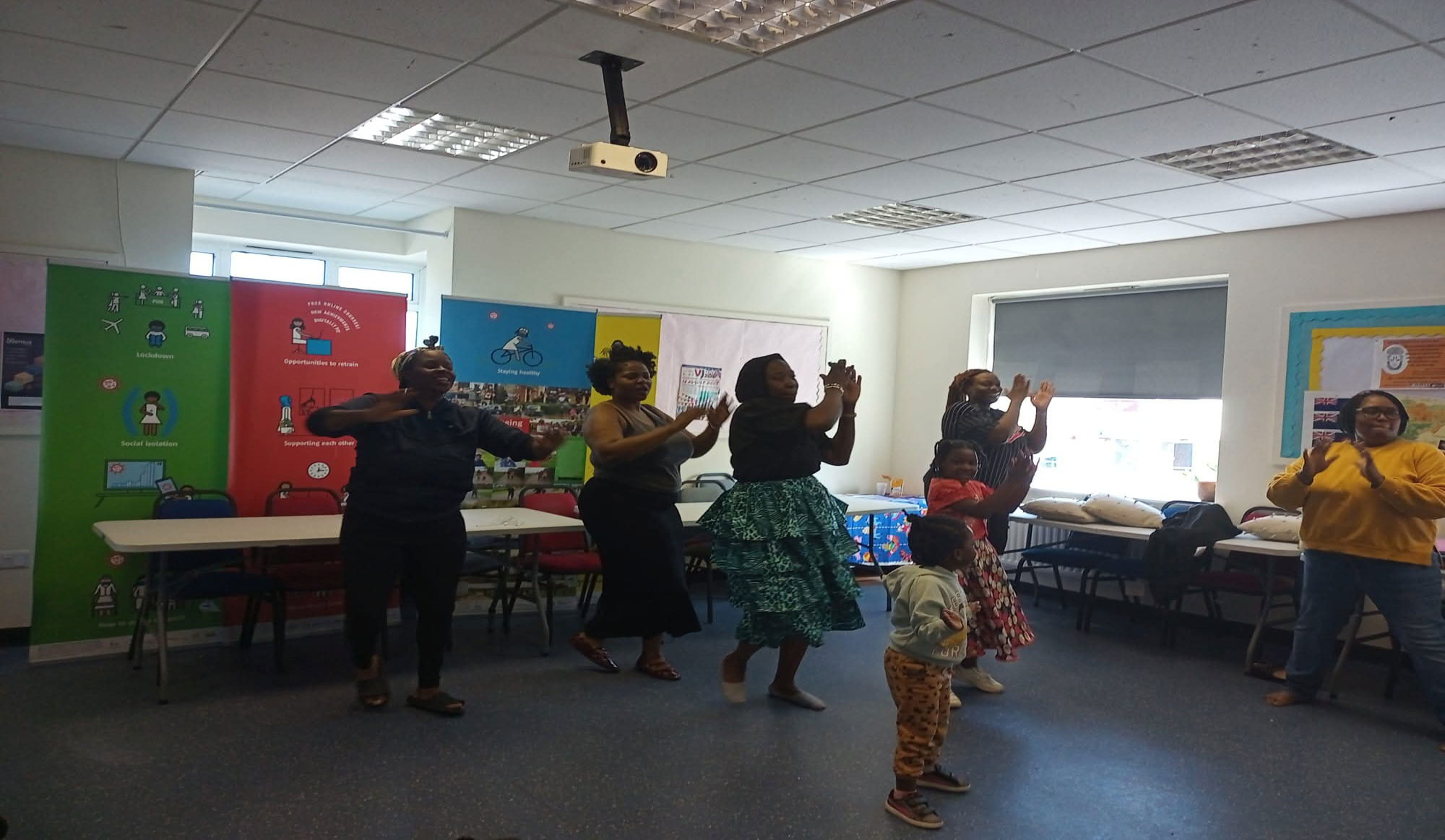
Picture 3. Mums dancing – Creating a welcoming, family-friendly environment where mothers can connect, learn and share.
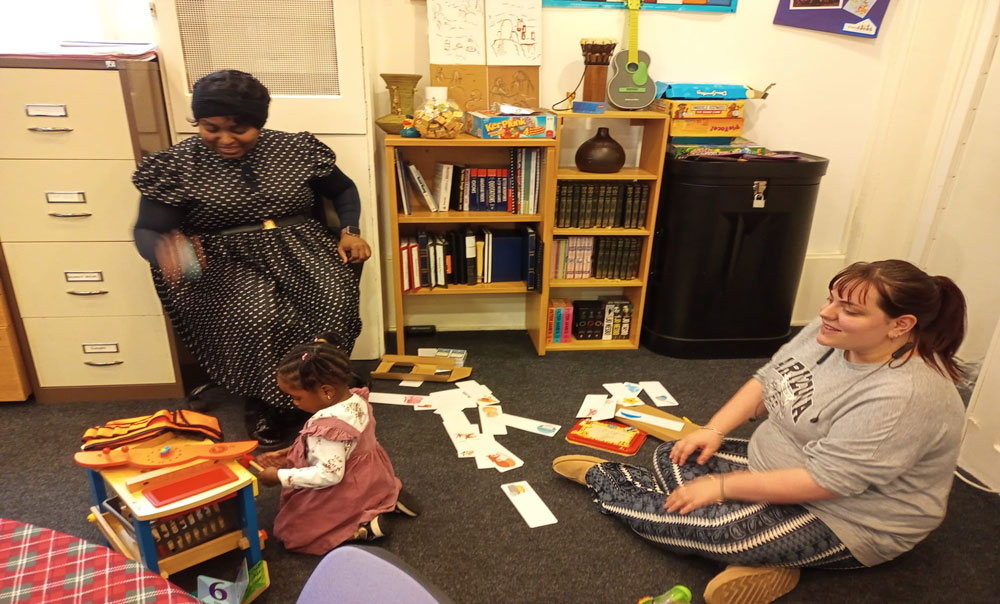
Picture 4. Two women and a young child taking part in an informal community activity with toys and learning materials.
The photographs from Swale Mums show something that a policy document cannot fully capture connection happening in real life.
One image shows mothers sitting together on mats, learning and participating in an informal activity. Another captures a more playful, family-friendly community environment. They demonstrate an important feature of the project:
Support does not have to be clinical, intimidating or formal to be meaningful.
Local experience shows the value of connection
There is already a strong local example of community-based perinatal mental-health support.
HUGS — Helping You Grow Stronger, developed by the perinatal mental-health team serving Medway and Swale, was established following increased referrals for pregnant women experiencing anxiety, low mood and social isolation. The programme consists of four 90-minute self-help sessions and has been expanded across Kent. Medway NHS Foundation Trust reports that HUGS has supported people in Medway and Swale and highlights benefits including practical mental-health tools, improved signposting and enhanced peer support (Medway NHS Foundation Trust, n.d.). The experience of HUGS reinforces an important principle: connection is not simply an optional extra alongside wellbeing support. For many people, connection is part of the support itself. Swale Mums builds on this wider local direction by creating a sustained community space where mothers can develop relationships, practical skills and confidence over 12 weeks.
From a weekly session to a lasting community
Perhaps the most important feature of Swale Mums is that the project is designed not simply to end after Week 12.
Participants can receive optional one-to-one peer support during the programme, while virtual resources and WhatsApp communication can provide continuity beyond face-to-face sessions. The enhanced model also includes peer mentoring, peer-led activities and an alumni network.
The intention is to move from:
“I came to a group.”
to:
“I found my people.”
That is the difference between a short-term activity and a community asset.
Measuring what matters
Swale Mums is designed to be both human-centred and evidence-informed.
The programme monitors attendance and engagement, gathers participant feedback and uses WEMWBS before and after the programme to help assess changes in mental wellbeing. Follow-up needs and referrals are also recorded.
This enables Diversity House to ask meaningful questions:
- Are mothers feeling less isolated?
- Are they becoming more confident about asking for help?
- Are they developing practical coping strategies?
- Are they better connected to local services?
- Are women who may be less likely to access conventional support being reached?
- Do peer relationships continue beyond the programme?
The aim is not simply to count attendance. It is to understand what changes for women because they took part.
Importantly, the project documentation sets out the evaluation approach but does not yet provide final outcome data. We therefore do not claim that Swale Mums has already demonstrated specific improvements in wellbeing. Instead, the programme has been designed to measure and learn from participants’ experiences. That is an important commitment to transparency.
Why Swale Mums matters
The evidence points in a consistent direction.
- Women need to be listened to.
- Mothers need support for their own wellbeing, not only support focused on their babies.
- Early intervention matters.
- Social connection matters.
- Culture and identity matter.
- Accessibility matters.
- Community matters.
Kent’s perinatal mental-health strategy places a strong emphasis on prevention, early intervention, reducing inequalities and developing flexible and culturally appropriate support. It also describes the value of intervening early to prevent difficulties becoming more severe and to support healthy development across generations (Kent County Council, 2024). That is exactly where Swale Mums sits.
It is not about telling mothers how to be better mothers. It is about creating the conditions in which mothers can feel supported enough to be themselves. And when mothers are supported, babies, families and communities benefit too.
A community that grows with its mums
Swale Mums Peer Support Circles represents a preventative, inclusive and community-rooted approach to women’s and family wellbeing. It brings together:
peer support + early intervention + mental-health literacy + practical wellbeing + cultural inclusion + community connection + pathways into professional support.
Most importantly, it starts with relationships:
- A conversation.
- A shared experience.
- A cup of tea.
- A laugh.
- A practical activity.
- A moment of recognition.
Sometimes those small moments are where wellbeing begins.
Diversity House is proud to create spaces where Swale mums can connect, grow in confidence and remind one another: you do not have to do motherhood alone.
References
Department of Health and Social Care (2022) Women’s Health Strategy for England. CP 736. London: Department of Health and Social Care. Available at: GOV.UK — Women’s Health Strategy for England (Accessed: 14 September 2026).
Department of Health and Social Care (2026) Renewed Women’s Health Strategy for England. London: Department of Health and Social Care. Available at: GOV.UK — Renewed Women’s Health Strategy for England (Accessed: 14 September 2026).
Diversity House (2026) Swale Mums Peer Support Circles: Activities and enhanced project schedule. Unpublished project document.
Kent County Council (2024) Nurturing Little Hearts and Minds: Perinatal Mental Health and Parent-Infant Relationships Strategy for Kent 2024–2029. Maidstone: Kent County Council. Available at: Kent County Council — Nurturing Little Hearts and Minds (Accessed: 14 September 2026).
Kent Public Health Observatory (n.d.) Health inequalities. Kent County Council. Available at: Kent Public Health Observatory — Health inequalities (Accessed: 14 September 2026).
Kent Public Health Observatory (n.d.) Swale. Kent County Council. Available at: Kent Public Health Observatory — Swale profile (Accessed: 14 September 2026).
Medway NHS Foundation Trust (n.d.) Maternal mental health service expands across Kent. Available at: Medway NHS Foundation Trust — Maternal mental health service expands across Kent (Accessed: 14 September 2026).
NHS England (2023) Supported self-management: peer support guide. London: NHS England. Available at: NHS England — Supported self-management: peer support guide (Accessed: 14 September 2026).
NHS England (n.d.) Perinatal mental health. London: NHS England. Available at: NHS England — Perinatal mental health (Accessed: 14 September 2026).