
The Role of Diversity House in Building Inclusive Communities and Global Partnerships
By Dr Christine Locke, Founder and Chief Executive Officer, Diversity House
Connecting local action with global priorities to advance inclusion, human dignity, community resilience and sustainable development.
Introduction: Two Agendas, One Shared Purpose
The world faces increasingly complex humanitarian and development challenges. Conflict, forced displacement, economic insecurity, climate change, persistent inequalities and barriers to social inclusion continue to affect individuals, families and communities across the globe.
Addressing these challenges requires more than emergency assistance or short-term interventions. It requires coordinated action that protects human dignity, strengthens community resilience, tackles structural inequalities and creates opportunities for people to participate fully in society.
This raises an important question: What is the difference between humanitarian action and development, and where does Diversity House fit within this wider landscape?
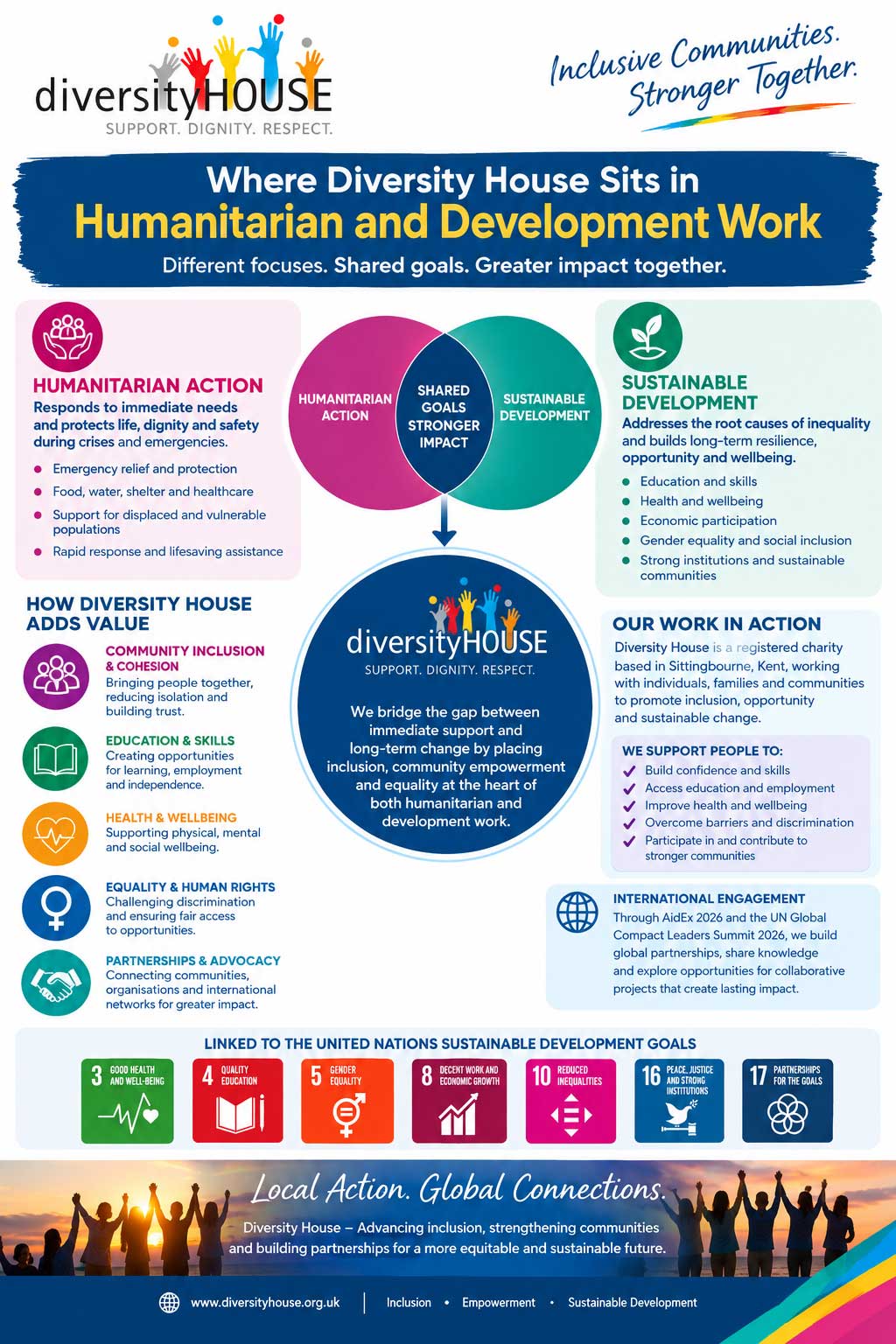
Humanitarian action and development have distinct objectives, approaches and time horizons. Humanitarian action primarily addresses urgent needs, protects life and alleviates suffering during emergencies. Development focuses on longer-term improvements in people’s lives by addressing inequalities, strengthening capabilities and creating sustainable opportunities.
However, these agendas are closely interconnected. Immediate assistance is often most effective when accompanied by measures that help people recover, rebuild their lives and strengthen their resilience. Similarly, development gains are more likely to endure when communities are better equipped to withstand and recover from crises (United Nations, 2015).
The United Nations’ 2030 Agenda for Sustainable Development recognises that poverty, inequality, human rights, environmental sustainability and inclusive economic progress must be addressed together. Its commitment to leave no one behind places human dignity, equality and participation at the centre of global progress (United Nations, 2015).
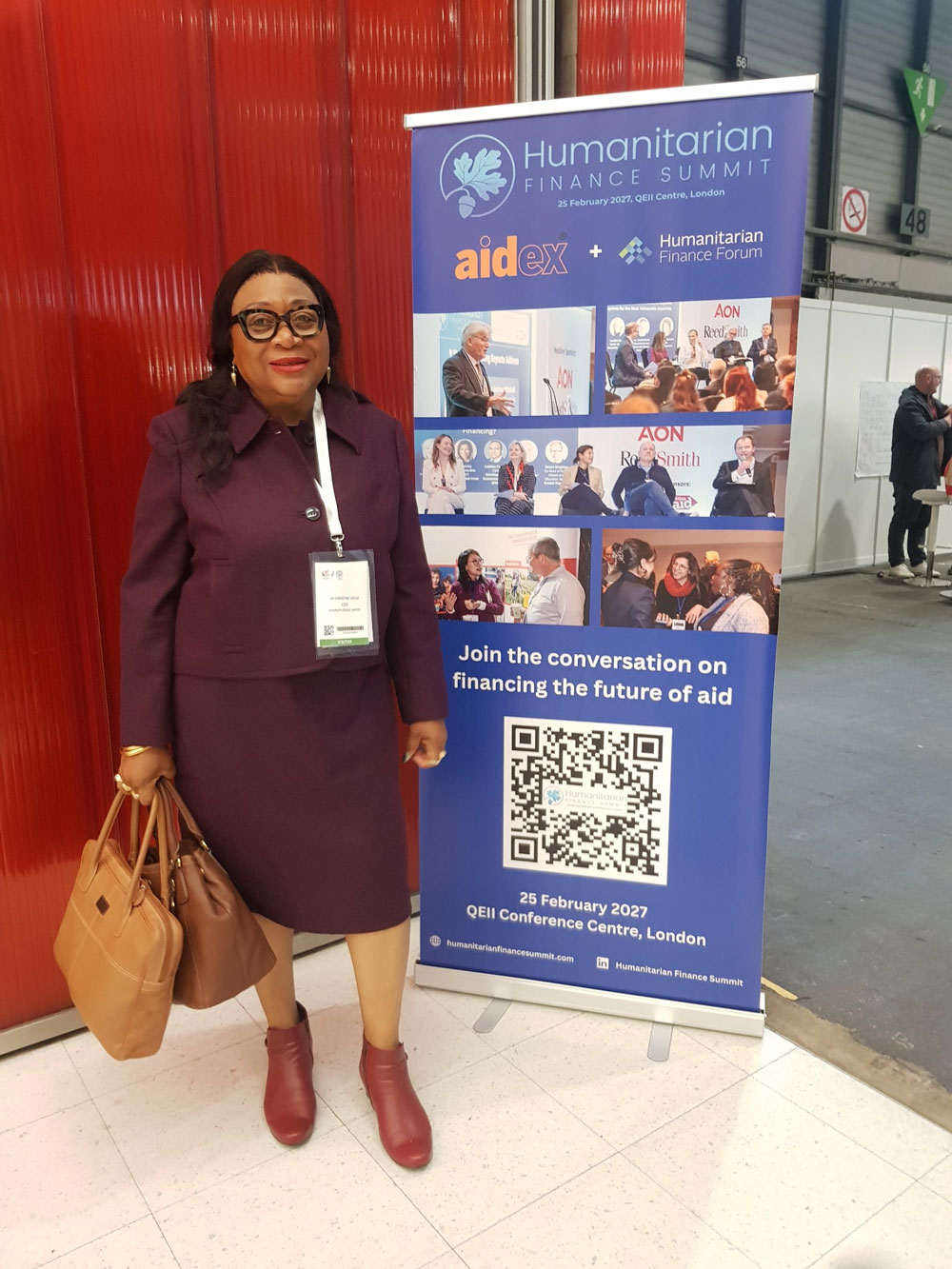
For Diversity House, these principles are directly relevant to our work promoting social inclusion, community cohesion, equality, empowerment and access to opportunities. Our participation in international forums, including AidEx 2026 in Geneva and the UN Global Compact Leaders Summit 2026 in New York, also reflects the importance of connecting local experience with international knowledge, partnerships and opportunities for collaborative action (AidEx, 2026; United Nations Global Compact, 2026).
The central argument is clear: humanitarian action addresses urgent human needs, development builds the foundations for lasting progress, and inclusion helps ensure that both respond to the people and communities they are intended to serve.
1. Humanitarian Action: Protecting Life, Dignity and Human Rights
Humanitarian action seeks to save lives, alleviate suffering and protect human dignity during emergencies and other situations of acute need. It may involve emergency food assistance, shelter, healthcare, protection services, clean water, sanitation and support for people displaced by conflict or disasters.
Humanitarian action is guided by the principles of humanity, impartiality, neutrality and independence. These principles help ensure that assistance is provided according to need and that the protection of human dignity remains central to humanitarian response (United Nations Office for the Coordination of Humanitarian Affairs, n.d.).
The urgency of humanitarian work often requires rapid assessment, effective coordination and the mobilisation of resources to reach people facing immediate threats to their safety and wellbeing. However, humanitarian needs do not always arise from sudden emergencies. Protracted conflicts, forced displacement, food insecurity and prolonged instability can leave communities facing severe hardship for years. In these situations, emergency assistance remains essential, but it may not be sufficient to address the wider circumstances that perpetuate vulnerability. People may also need access to education, livelihoods, psychological and social support, community networks and opportunities to rebuild their lives. This is where humanitarian action and development begin to intersect.
Humanitarian organisations have a vital role in emergency response and protection. Community organisations, development agencies, governments and other partners can contribute complementary expertise to recovery, inclusion and longer-term resilience. The challenge is to ensure that these efforts are coordinated, responsive to local circumstances and focused on the dignity and agency of the people concerned.
2. Development: Addressing Inequality and Creating Sustainable Opportunities
Development is concerned with improving people’s quality of life over time by addressing the social, economic, institutional and environmental factors that influence their opportunities and wellbeing.
It encompasses education, health, employment, gender equality, social protection, economic participation, community empowerment and institutional capacity.
Development is not simply about economic growth. It also concerns whether people can access services, exercise their rights, participate in decision-making and pursue meaningful opportunities.
The United Nations’ 2030 Agenda identifies 17 interconnected Sustainable Development Goals, addressing areas including poverty, health, education, gender equality, reduced inequalities, sustainable communities and international partnerships (United Nations, 2015).
These goals recognise that progress in one area can depend on progress in others.
For example, improving access to employment may require skills development, education, accessible services and measures to address discrimination. Strengthening community wellbeing may require not only healthcare but also social connections, economic security and a sense of belonging.
Similarly, addressing discrimination requires more than responding to individual incidents. It also requires education, organisational accountability, inclusive policies and opportunities for people from different backgrounds to participate equally.
Development therefore involves strengthening people’s capabilities and addressing the barriers that prevent them from realising their potential.
For Diversity House, this understanding is central to our community-based approach. Our work supports individuals and communities through culturally appropriate services, information, advice, advocacy, education, training and initiatives that promote inclusion and participation (Diversity House, n.d.-a).
These activities contribute to the wider development agenda by helping people navigate barriers, access opportunities and strengthen their connections with the communities in which they live.
3. Humanitarian Action and Development: Understanding the Differences
Although humanitarian action and development share a concern for human wellbeing, their immediate priorities differ.
|
Dimension |
Humanitarian action |
Development |
|
Primary purpose |
Save lives, alleviate suffering and protect dignity |
Improve wellbeing and address structural inequalities |
|
Time horizon |
Often immediate and short-term, although responses may continue for years |
Usually medium- to long-term, with some immediate interventions |
|
Main priorities |
Emergency assistance, protection and essential services |
Education, livelihoods, inclusion, institutions and sustainable opportunities |
|
Approach |
Respond to urgent needs according to humanitarian principles |
Strengthen capabilities, systems and opportunities for lasting progress |
|
Intended outcomes |
Reduced suffering, protection and access to essential assistance |
Greater resilience, reduced disadvantage and sustainable improvements in quality of life |
These distinctions are useful, but they should not be interpreted as a rigid separation.
The humanitarian–development–peace nexus provides an important framework for understanding how humanitarian, development and peacebuilding actors can work in complementary ways. It encourages greater coordination between immediate crisis response and longer-term efforts to address vulnerability, strengthen resilience and support sustainable progress (United Nations Development Programme, n.d.).
The purpose is not to make every organisation perform the same function. Rather, it is to encourage different actors to work towards complementary outcomes while respecting their respective responsibilities and expertise.
For example, an emergency response may provide immediate shelter and protection to displaced families. Longer-term development efforts may help those families access education, employment, community networks and essential services.
Similarly, community-based initiatives that strengthen trust, reduce exclusion and improve access to support may contribute to the social conditions needed for people to recover from hardship and participate more fully in society.
Diversity House does not replace specialist humanitarian agencies. Our contribution lies in community development, inclusion, empowerment and social cohesion—areas that are relevant to the wider development agenda and can complement humanitarian and recovery efforts.
Recognising this distinction is important for maintaining a clear organisational identity while identifying opportunities for collaboration.
4. Where Diversity House Fits Within the Humanitarian and Development Landscape
Diversity House was formally established in 2007 and is based in Sittingbourne, Kent. The charity works to promote community integration, social inclusion, equality and cohesion across Swale and the wider Kent area (Diversity House, n.d.-b).
Our work is rooted in the understanding that individuals, regardless of their backgrounds or circumstances, should be treated with dignity and respect and have appropriate opportunities to access services and participate in community life.
Diversity House’s published services include advice, information, advocacy, health promotion, education, training, mentoring, cultural awareness, employability support and activities that encourage community engagement. The organisation also works with service providers to strengthen culturally proficient practice and improve engagement with communities that may experience barriers to accessing services (Diversity House, n.d.-a).
This places Diversity House within the community development and social inclusion landscape, with relevance to several interconnected dimensions of sustainable development.
4.1 Social inclusion and community cohesion
Communities are stronger when people feel respected, connected and able to participate in decisions and activities that affect their lives.
However, discrimination, isolation, language barriers, unequal access to services and socioeconomic disadvantage can prevent individuals from realising their potential.
Diversity House promotes cultural understanding, equality, community participation and opportunities for meaningful engagement (Diversity House, n.d.-a).
Our approach recognises that community cohesion is more than the absence of conflict. It involves building trust, strengthening relationships and creating environments in which people from different backgrounds can contribute to shared community life.
This work is relevant to sustainable development because exclusion can undermine access to opportunities, weaken social relationships and prevent people from participating fully in society.
By supporting inclusive communities, Diversity House contributes to the broader objective of ensuring that development benefits are accessible to people from diverse backgrounds (United Nations, 2015).
4.2 Education, skills and economic participation
Education and skills development are important foundations for independence, economic participation and improved quality of life.
People who experience barriers to education, training or employment may face prolonged disadvantage and reduced opportunities to improve their circumstances.
Diversity House provides support through activities such as training, mentoring, employability guidance and access to information and services (Diversity House, n.d.-a).
Such support can help individuals build confidence, develop practical capabilities and explore opportunities for participation in employment and community life.
These activities align with the wider objectives of SDG 4, which promotes inclusive and equitable quality education, and SDG 8, which promotes decent work and inclusive economic growth (United Nations, 2015).
The wider development significance is that investment in people can strengthen individual capabilities while supporting more inclusive communities.
4.3 Health, wellbeing and empowerment
Health and wellbeing are influenced by more than access to medical treatment. Social relationships, economic circumstances, education, cultural understanding and access to appropriate support all affect people’s quality of life.
Diversity House’s community-based services include health promotion, health education, mentoring and support designed to help individuals access information and appropriate services (Diversity House, n.d.-a).
Our work supporting women and other groups experiencing disadvantage is also relevant to the development agenda, particularly where barriers to participation, unequal opportunities or social exclusion affect wellbeing.
Gender equality and empowerment are central to SDG 5, while SDG 3 recognises the importance of ensuring healthy lives and promoting wellbeing for all (United Nations, 2015).
An inclusive development approach recognises that people may face different barriers to accessing support. Services therefore need to be responsive to individual circumstances, cultural contexts and overlapping forms of disadvantage.
4.4 Equality, diversity and human rights
Development cannot be considered sustainable if particular groups remain excluded from its benefits.
Discrimination and unequal access to opportunities can reinforce social and economic disadvantage across generations.
Diversity House’s approach recognises the importance of equality, diversity, inclusion and intersectionality. Intersectionality is particularly relevant because individuals may experience multiple, overlapping forms of disadvantage associated with factors such as ethnicity, gender, disability, age and socioeconomic circumstances.
The United Nations’ 2030 Agenda calls for the reduction of inequalities and the promotion of peaceful, inclusive societies (United Nations, 2015).
For Diversity House, these commitments reinforce the importance of culturally appropriate services, awareness-raising, advocacy, community participation and collaboration with organisations responsible for delivering services.
Inclusion must be reflected in practice, not simply in organisational statements.
4.5 Community participation and institutional engagement
Effective development depends on understanding the experiences and priorities of the people it seeks to benefit.
Diversity House works with individuals, communities and service providers to promote participation, improve cultural understanding and encourage constructive engagement (Diversity House, n.d.-a).
This work can help organisations identify barriers that might otherwise remain overlooked and consider how services can become more accessible and responsive.
Community participation also supports accountability by creating opportunities for people to communicate their experiences, express their needs and contribute to decisions affecting their lives.
The United Nations’ 2030 Agenda emphasises inclusive participation, effective institutions and partnerships as important components of sustainable development (United Nations, 2015).
For development organisations, listening to communities is not an optional addition to programme delivery. It is an important part of designing relevant interventions and assessing whether they are producing meaningful outcomes.
5. Connecting Local Action with the United Nations Sustainable Development Goals
The Sustainable Development Goals provide a shared international framework for addressing poverty, inequality, health, education, gender equality, decent work, sustainable communities and other interconnected challenges.
Adopted by all United Nations Member States in 2015, the 2030 Agenda calls for collective action across governments, civil society, businesses and other stakeholders to advance sustainable development and ensure that no one is left behind (United Nations, 2015).
Diversity House’s work has clear relevance to several of these goals.
SDG 3: Good Health and Well-being
Health promotion, wellbeing support and access to appropriate information can contribute to healthier, more resilient communities.
SDG 4: Quality Education
Education, training and skills development help create opportunities for lifelong learning, personal growth and participation.
SDG 5: Gender Equality
Supporting women and girls, addressing barriers to participation and promoting empowerment contribute to the wider objective of gender equality.
SDG 8: Decent Work and Economic Growth
Employability guidance, skills development and access to relevant information can help individuals explore economic opportunities and strengthen their prospects for workforce participation.
SDG 10: Reduced Inequalities
Promoting equality, challenging discrimination and improving access to services are directly relevant to efforts to reduce social and economic exclusion.
SDG 16: Peace, Justice and Strong Institutions
Community cohesion, respect for rights, inclusive participation and constructive engagement between communities and institutions support more inclusive societies.
SDG 17: Partnerships for the Goals
Collaboration between charities, public bodies, businesses, civil society organisations and international partners can strengthen the knowledge, resources and relationships available to address shared challenges.
These connections demonstrate that the SDGs are not exclusively the responsibility of governments or large international organisations. Community-based charities also have an important role in translating global commitments into local practice (United Nations, 2015).
For Diversity House, the priority is to maintain a clear connection between our mission, our programmes, our partnerships and the outcomes experienced by the communities we serve.
6. Why International Engagement Matters: Lessons from AidEx 2026
International events provide opportunities to learn from different approaches, establish professional relationships and explore partnerships that may not emerge through local engagement alone.
AidEx 2026 took place at Palexpo in Geneva on 21–22 October 2026, bringing together stakeholders from the humanitarian aid and disaster relief sectors. Its programme provided a platform for engagement with organisations and professionals working across humanitarian assistance and related areas (AidEx, 2026).
For Diversity House, participation in this international environment provided an opportunity to engage with wider conversations about humanitarian challenges, development priorities and collaboration.
Under the leadership of Dr Christine Locke, Founder and CEO, Diversity House engaged in important meetings and discussions with colleagues and potential partners from Canada, the United Arab Emirates, Cameroon, the United Kingdom, France and other international communities.
These conversations created opportunities to exchange perspectives, explore shared interests and consider areas for future cooperation.
Their significance lies not simply in attendance, but in the potential to develop relationships that can support practical action.
International engagement can help community organisations:
- Learn from approaches developed in different social, cultural and institutional contexts.
- Identify potential partners with complementary expertise and objectives.
- Explore opportunities for collaborative projects and knowledge exchange.
- Strengthen understanding of emerging humanitarian and development priorities.
- Identify potential sources of expertise, technical support and resources.
- Bring community-level experience into wider discussions about inclusion and sustainable development.
For a community-based charity, these opportunities can be particularly valuable. They connect practical experience of addressing disadvantage with wider conversations about how development initiatives can become more inclusive, responsive and sustainable.
The meetings at AidEx 2026 have opened promising possibilities for Diversity House to strengthen its international relationships and explore development partnerships.
The next step is to maintain communication, identify shared priorities and establish whether these conversations can develop into practical initiatives.
It is important to distinguish between potential and confirmed outcomes. The meetings have created opportunities for further engagement, but any future partnerships will require continued discussion, agreed objectives, appropriate planning and commitments from the organisations involved.
For Diversity House, the real value of AidEx 2026 will be measured by what these relationships enable us to achieve after the event.
7. The UN Global Compact Leaders Summit 2026: Responsible Leadership and Sustainable Impact
International engagement also provides opportunities to consider how global sustainability principles can inform organisational practice.
The UN Global Compact Leaders Summit 2026 took place in New York on 22–23 September. Its programme focused on leadership, sustainability, human rights, decent work, sustainable finance and collective action (United Nations Global Compact, 2026).
Although the summit has a strong business sustainability focus, many of its themes are relevant to charities and community organisations.
Responsible leadership, human rights, transparent governance, collaboration and long-term resilience are important across the voluntary, public and private sectors.
For Diversity House, these principles reinforce the importance of ensuring that our values are reflected in our organisational decisions, programmes, partnerships and accountability.
Responsible leadership requires organisations to demonstrate credibility, maintain trust, use resources appropriately and remain responsive to the people they serve.
It also requires a willingness to assess progress, learn from experience and improve practices where necessary.
The UN Global Compact provides a framework for businesses and participating organisations to align their strategies and operations with principles relating to human rights, labour, the environment and anti-corruption, while contributing to the Sustainable Development Goals (United Nations Global Compact, n.d.).
Diversity House’s published organisational information includes its voluntary Communication on Engagement, describing its work and commitments in relation to these principles and the SDGs (Diversity House, n.d.-b).
This provides a basis for connecting international commitments with local practice.
The wider lesson is that sustainability should not be treated as a separate activity or a communications exercise. It should inform how organisations operate, work with others and assess the consequences of their decisions.
For Diversity House, engagement with international sustainability discussions can help strengthen learning, inform partnership development and support continued reflection on how our work contributes to inclusive and sustainable communities.
8. From International Meetings to Meaningful Partnerships
International events create opportunities, but lasting development depends on what organisations do with them.
Following AidEx 2026 and the UN Global Compact Leaders Summit 2026, an important priority for Diversity House is to strengthen the connections between international engagement and its community-based mission.
This requires a deliberate and practical approach to partnership development.
First, relationships must be maintained through continued communication and the identification of shared interests.
Second, prospective partners need to establish where their objectives, expertise and resources complement one another.
Third, proposed initiatives should respond to clearly identified needs and respect the experiences and priorities of the communities they seek to serve.
Finally, partnerships need realistic plans, appropriate governance, clear responsibilities and a commitment to assessing their outcomes.
For Diversity House, potential areas for future collaboration include:
- Inclusive community development: Sharing approaches that promote participation, social cohesion and equal opportunities.
- Women’s empowerment: Exploring initiatives that strengthen skills, confidence, access to opportunities and participation.
- Education and capacity building: Facilitating knowledge exchange, training and organisational learning.
- Equality and cultural awareness: Supporting approaches that improve understanding, reduce discrimination and strengthen culturally appropriate services.
- Community wellbeing: Exploring ways to improve access to information, support and opportunities for participation.
- International knowledge exchange: Learning from partners working in different contexts and identifying approaches that may be adapted to local needs.
These are potential areas for exploration rather than confirmed international projects. Their feasibility and value will depend on further discussions, partner alignment and the resources available.
Nevertheless, the opportunities are significant. International relationships can help Diversity House broaden its understanding, share its experience and explore approaches that strengthen its programmes and contribution to development.
Partners may also benefit from learning about community-based approaches to inclusion, empowerment and social cohesion developed through Diversity House’s work in Kent. The objective is to build relationships based on mutual benefit, shared learning and practical outcomes rather than one-way exchanges.
The United Nations’ 2030 Agenda identifies partnerships as essential to achieving sustainable development, recognising that governments, civil society, businesses and other stakeholders all have roles to play (United Nations, 2015).
For Diversity House, this principle translates into a practical ambition: to build partnerships that are purposeful, inclusive, sustainable and capable of delivering measurable benefits.
9. Measuring Success: From Commitments to Evidence
A credible approach to humanitarian and development work must recognise that good intentions and participation in events are not, by themselves, evidence of impact.
Organisations need to understand whether their activities are making a difference, whom they are reaching and what can be improved.
The United Nations’ 2030 Agenda emphasises the importance of follow-up, review and reliable data in assessing progress towards sustainable development (United Nations, 2015).
For Diversity House, this means continuing to strengthen the connection between programme objectives, community needs, partnership development and measurable outcomes.
Depending on the initiative, relevant indicators might include:
- Participation in education, training and skills development.
- Access to information, advice and support services.
- Improvements in confidence, knowledge and practical capabilities.
- Engagement by groups that experience barriers to participation.
- Strengthened organisational capacity and collaboration.
- The development and continuation of effective partnerships.
- Feedback from service users and evidence of improved access to opportunities.
International collaboration should also be assessed by its practical contribution.
Did discussions lead to sustained relationships? Were shared priorities identified? Did partners develop a realistic initiative? Were additional expertise or resources mobilised? Did the resulting activity produce demonstrable benefits for the intended communities?
These questions help distinguish between activity and impact.
They also support transparency, learning and accountability to service users, partners, funders and the wider public.
A commitment to continuous improvement is essential if Diversity House is to strengthen its contribution to inclusive development and build partnerships capable of delivering long-term value.
10. The Way Forward: Local Roots, International Partnerships and Shared Responsibility
Humanitarian action and development should not be viewed as competing agendas. They are complementary approaches that respond to different dimensions of human need.
Humanitarian action protects life and dignity during crises. Development addresses the conditions that shape people’s opportunities, resilience and long-term wellbeing. When these approaches are coordinated effectively, they can help communities move beyond repeated cycles of vulnerability towards greater stability and opportunity (United Nations, 2015).
Diversity House contributes to this wider landscape through its commitment to social inclusion, community cohesion, equality, education, wellbeing and empowerment.
Our work is rooted in local communities, but the challenges we address have wider significance. Discrimination, social exclusion, unequal access to opportunities and barriers to participation are not confined to one country or community.
Learning from international experience and developing constructive partnerships can help organisations respond more effectively to these shared challenges.
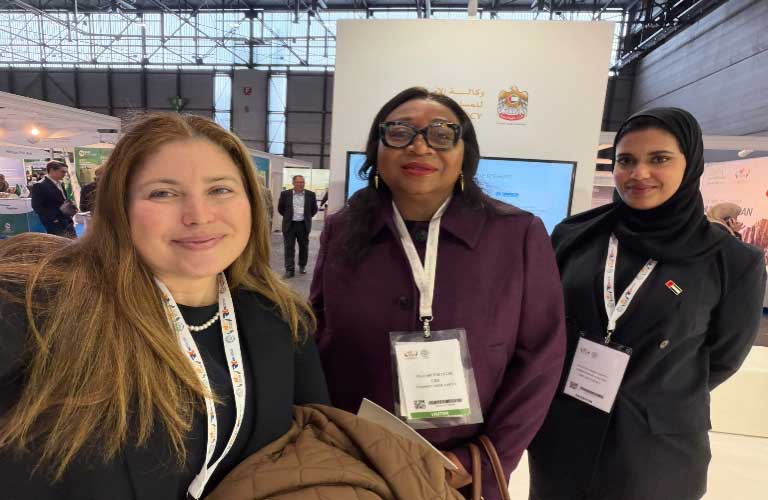
Shawna Novak(CISEPO), Dr C. Locke , Marwa Raslan (UAE AID AGENCY)
AidEx 2026 and the UN Global Compact Leaders Summit 2026 have provided valuable opportunities for engagement, reflection and relationship-building. The conversations and connections emerging from these events offer a foundation on which future cooperation may be developed.
The next step is to turn that potential into practical, appropriately resourced and measurable initiatives.
For Diversity House, this means remaining grounded in the needs of the communities we serve while being open to the knowledge, partnerships and opportunities that international collaboration can offer.
It also means continuing to demonstrate that inclusion is not separate from sustainable development. It is one of the conditions that makes development more equitable, responsive and effective.
Conclusion: Making Inclusion Central to Development
The distinction between humanitarian action and development is important, but the relationship between them is equally significant.
Immediate assistance is essential when people face crises. Long-term development is necessary to address disadvantage, strengthen resilience and create opportunities for people to thrive.
Both approaches are strengthened when they recognise human dignity, respect diversity and ensure that people affected by decisions have opportunities to participate in shaping them.
For Diversity House, this is more than a theoretical position. It reflects the purpose of our work and the principles that guide our engagement with communities, organisations and international partners.
Through our community-based programmes, commitment to the Sustainable Development Goals and participation in international forums, we seek to strengthen the connections between local experience and wider development priorities.
As we build on the relationships established through AidEx 2026 and the UN Global Compact Leaders Summit 2026, our focus remains on collaboration that has a clear purpose, partnerships built on trust and initiatives that can make a meaningful difference.
Our ambition is clear: to connect local action with global learning, place inclusion at the heart of development and build partnerships that create lasting opportunities for individuals and communities.
Sustainable progress is not measured solely by the commitments we make or the meetings we attend. It is measured by the barriers we help remove, the opportunities we help create and the positive changes that people experience in their lives.
Diversity House — advancing inclusion, strengthening communities and building partnerships for sustainable development.
References
AidEx (2026) AidEx 2026: When & Where. Available at: AidEx 2026 event information (Accessed: 23 October 2026).
Diversity House (n.d.-a) What we do. Available at: Diversity House: What we do (Accessed: 23 October 2026).
Diversity House (n.d.-b) About us. Available at: Diversity House: About us (Accessed: 23 October 2026).
United Nations (2015) Transforming our world: the 2030 Agenda for Sustainable Development. New York: United Nations. Available at: United Nations: The 2030 Agenda for Sustainable Development (Accessed: 23 October 2026).
United Nations Development Programme (n.d.) Humanitarian-development-peace nexus. Available at: UNDP: Crisis prevention and recovery (Accessed: 23 October 2026).
United Nations Global Compact (2026) UN Global Compact Leaders Summit 2026. Available at: UN Global Compact Leaders Summit (Accessed: 23 October 2026).
United Nations Global Compact (n.d.) The Ten Principles of the UN Global Compact. Available at: UN Global Compact: The Ten Principles (Accessed: 23 October 2026).
United Nations Office for the Coordination of Humanitarian Affairs (n.d.) OCHA on message: Humanitarian principles. Available at: OCHA: Humanitarian principles (Accessed: 23 October 2026).